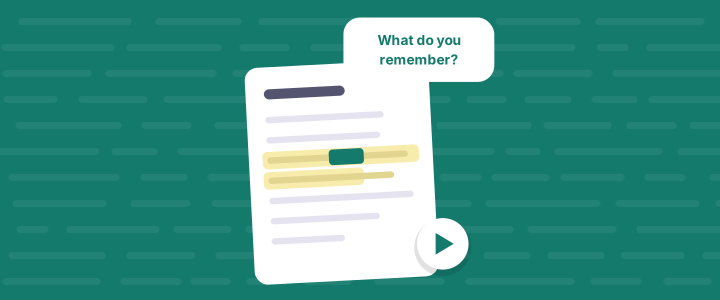
Text to speech helps you study when you follow the words on screen and stop every few pages to recall what you heard. Listening on its own is no better than reading, and it’s where minds wander most.
That’s the short version of six studies. Here is what each one found, and what it means for how you study, whatever reader you use.
- No shortcutListening instead of readingSame understanding as reading, and more drifting
- HelpsRead-aloud for readers who struggle with printA small but real gain across 22 studies
- Helps mostStopping to recall between sectionsHalf the mind wandering, and more learned
- HelpsChecking what you missedRecall plus the right answers did best
1. Listening alone isn’t a shortcut
Rogowsky, Calhoun & Tallal, 2016 · Varao Sousa, Carriere & Smilek, 2013
In one study, 91 people took in the same nonfiction chapter as an audiobook, as text, or both at once. Their comprehension came out the same in all three, right away and two weeks later. In another, more than 200 people read passages silently, read them aloud, or listened to someone else read. Listening was where their minds wandered most, about half the times they were asked, and it left them remembering the least.
What to do with it: if you use text to speech, keep the words in front of you and follow along. Save eyes-closed listening for a second pass.
2. For readers who struggle with print, it helps
Wood, Moxley, Tighe & Wagner, 2018, a review of 22 studies
Pooling 22 studies of students with reading disabilities, the authors found that having text read aloud, by a computer or a person, improved reading comprehension. The gain was small but real, and it didn’t depend on grade level.
What to do with it: if getting through the words is the hard part, having them read to you is worth trying, and the evidence is on your side.
3. Stopping to recall cuts the drifting
Szpunar, Khan & Schacter, 2013 · Roediger & Karpicke, 2006
Students watched a 21-minute lecture in four parts. Some answered a short quiz after every part; the others didn’t. The quizzed group’s minds wandered on about one check in five, against about two in five for everyone else, and they took more notes and scored higher on the final test. In the older study, students who recalled a passage instead of rereading it remembered more a week later, even though rereading felt like it was working better.
What to do with it: break your reading at the headings. At each one, look away and write down what you remember before you go on.
4. Checking what you missed locks it in
Kang, McDermott & Roediger, 2007
Students read journal articles, then reviewed them in different ways. Writing short answers from memory and then seeing the correct ones was the strongest of the ways they tried, three days later.
What to do with it: after you write what you remember, compare it with the page and fill in what you left out. The gaps are what you study next.
Where Hearald fits
| The research says | What Hearald does |
|---|---|
| Keep the words in front of you | Lights up each word as it’s spoken, so your eyes follow along instead of only listening. |
| Read-aloud helps readers who struggle with print | Free. Reads web pages, PDFs and Google Docs in a voice that runs on your computer and works offline. |
| Stop and recall at each section | Marks each section on the player, and gives you a note to write what you remember. |
| Check what you missed | The check lists the section’s key points and shows which ones your note missed. |
The note and check are part of the Study Kit, and your first three notes are free. Nobody has studied Hearald itself: it’s built on these findings, not proof of them.
What these studies don’t tell you
- Most were short sessions, not a semester of studying.
- The quiz study used a video lecture, not reading. The idea carries over, but it wasn’t tested on a textbook.
- None of them measured word-by-word highlighting on its own.
- In the first study, reading and listening together wasn’t better than either one alone. The gain in finding 2 is for people who struggle with print.
Check yourself
Finding 3, used on this page: answer from memory, then open the answers.
- In the 2013 lecture study, about how often did the quizzed students’ minds wander, compared with everyone else?
- Which readers did the review of 22 studies find text to speech helps?
- You listen to a chapter on a walk, eyes off the text, and feel like you got it. What do these studies say the risk is, and what would you add?
Show answers
- About one check in five, against about two in five.
- Students with reading disabilities: a small but real gain in comprehension.
- Listening alone is where minds wander most, and feeling like you got it isn’t the same as remembering it. Afterwards, write down what you remember and check it against the text.
Try it
If you want text to speech that keeps the words in front of you and gives you a place to stop and recall, give Hearald a shot and put it in your browser.