For the gist, yes: listeners understood a chapter as well as readers, right away and two weeks later. Readers pull ahead when they set the pace and the questions need inference; that gap narrows when you listen and read together.
“Is listening to an audiobook as good as reading” has a cleaner answer than the argument suggests. Six studies mostly agree: the brain builds the same meaning either way, listening alone drifts more, and those who find print hardest gain most from hearing the words.
- HelpsListening for the gistAudiobook and e-text scored the same, now and two weeks later.
- MixedReading when you set the paceReaders edged ahead only when self-paced, on inference questions.
- No shortcutListening with your eyes elsewhereMinds wandered on half the probes while listening, a third while reading silently.
- Helps mostHearing and seeing the words togetherTeenagers with dyslexia read more accurately after five months of audiobooks.
1. For the gist, listening keeps up with reading
Rogowsky, Calhoun & Tallal, 2016 · Deniz, Nunez-Elizalde, Huth & Gallant, 2019
Ninety-one adults took in a 3,184-word chapter of Unbroken as audiobook, e-text, or both with the words highlighted. On a 48-question test the groups scored 30.9, 31.3 and 31.5, and two weeks later they were still level. Brain scans agree: the cortex maps of meaning from listening to and reading the same stories were alike enough that a model built from one predicted the other.
What to do with it: Stop treating the audiobook as the lesser version; choose by what fits your day.
2. Readers pull ahead when they control the pace
If listening to an audiobook is as good as reading for the gist, where does reading earn its reputation? A meta-analysis of 46 studies and 4,687 people found no overall difference (g = 0.07). Self-paced readers had a small edge (g = 0.13); literal questions came out even (g = −0.01) while inference questions favored reading (g = 0.36). The likely reason is not that eyes beat ears: a reader can stop and reread, and a listener on a fixed track cannot.
What to do with it: When you need to connect ideas, take the controls: pause and go back.
3. Listening alone invites your mind to wander
Varao Sousa, Carriere & Smilek, 2013
About 211 students read one excerpt of Bill Bryson’s A Short History of Nearly Everything silently, read one aloud and listened to one. They reported mind wandering on about 51 percent of probes while listening and 36 percent while reading silently. Listening also left the worst memory for the passage.
What to do with it: Give your eyes a job. Keep the text in front of you, or pause after each section and say back what it covered.
4. Hearing and seeing the words together helps most where print is hardest
Milani, Lorusso & Molteni, 2010 · Clinton-Lisell, 2023
Twenty Italian adolescents with dyslexia used audiobooks of their school books for five months while twenty others kept to print. The audiobook group improved significantly in reading accuracy and did better at school; only the abstract is available, without effect sizes. A second meta-analysis of 30 studies on reading while listening found a small benefit over reading alone (g = 0.18) that held when the pace was set for the reader (g = 0.41) and vanished when readers paced themselves. Struggling readers and second-language learners may gain more, but from too few studies to be sure.
What to do with it: If print is slow for you or English is new to you, play the audio and follow the words.
Where Hearald fits
| Finding | What Hearald does |
|---|---|
| Listening keeps up for the gist | Reads web pages, PDFs and Google Docs aloud. |
| Readers win when they control the pace | The player marks each section and jumps between them, so you can go back. |
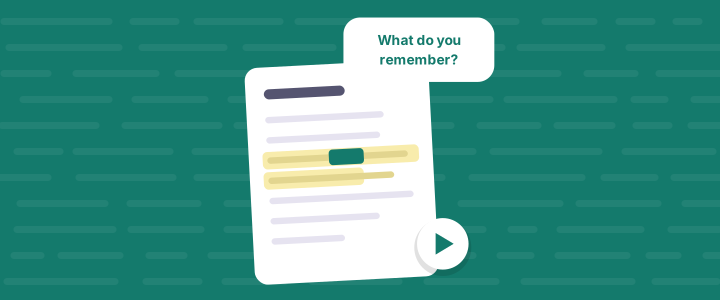
| Listening alone drifts | Highlights each word as it is spoken. After a section, you write what you remember in a note and the check shows which key points you missed. |
| Hearing and seeing together helps most | Audio and highlighted text at once; the voice runs on your computer and works offline. |
Nobody has run a study on Hearald itself. It puts you in the conditions these studies found helpful.
What these studies don’t tell you
- Most comparisons used short passages in one sitting, often with one narrator, not a semester. The adult study used a narrative, not a textbook, had no printed-book group, and was funded by Audible.
- The dyslexia trial is 40 students in an abstract; its audiobooks came with schoolwork, so audio cannot be separated from extra time with the books.
- The fixed-pace results come from experimenters setting the speed. A listener who pauses and rewinds freely was rarely tested.
Check yourself
- In the 46-study meta-analysis, which kind of question favored reading: literal or inference?
- What is the one thing to do when you listen to material you need to connect ideas across?
- You put on an audiobook of a textbook chapter while washing dishes. Based on finding 3, what is likely to happen, and what would fix it?
Show answers
- Inference questions (g = 0.36). Literal questions came out even.
- Take the controls: pause and go back, rather than letting the narration run at its own pace.
- Your mind will drift more than if you were reading, roughly half the time in the study. Keep the words in view while the audio plays, or pause after each section and say back what it covered.
Try it
If you want to hear and see the words at the same time on the pages you already read, give it a shot and put it in your browser.