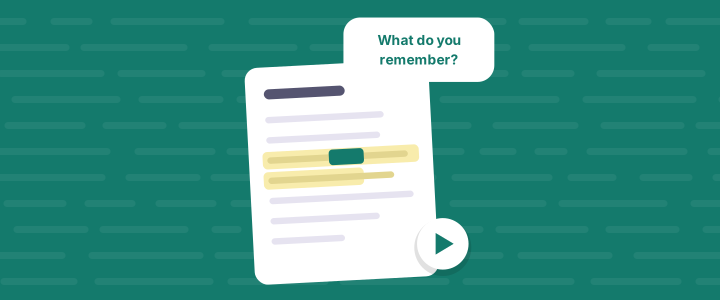
Writing down what you remember from a section, then comparing it against the section’s key points, is one of the best-supported study moves there is. It takes about a minute and tells you exactly what to go back for.
Most of us check our understanding by rereading, and the feeling of recognition gets mistaken for knowing. The note and check is built around the opposite move: close the page, write what you heard, and let the gaps show themselves.
What it’s for
Recalling material from memory does more for later retention than reading it again. In a 2006 experiment, students read short prose passages and then either reread them or wrote out everything they could recall, with no feedback. Five minutes later the rereaders did slightly better; two days and a week later, the students who had written from memory remembered substantially more, even though rereading had left them more confident (Roediger and Karpicke, 2006). A later study with 200 students found that reading a science text and recalling it from memory beat drawing concept maps of the same text by about 50 percent a week later, including on inference questions, while most students had predicted the opposite (Karpicke and Blunt, 2011).
The second half of the move is the check. In a 2008 study, students who got feedback after a test on passages they had read remembered more correct material and fewer errors on a delayed test than students who got none, whether the feedback came at once or later (Butler and Roediger, 2008). Without a check, you can write a confident note that skips a third of the section and never find out.
And almost nobody does this unprompted. When 177 undergraduates listed their study strategies, 84 percent named rereading and 11 percent named testing themselves; the few who did self-test mostly did it to find out what they knew, not because they thought the recall itself was teaching them (Karpicke, Butler and Roediger, 2009). In the moment, rereading feels better. A tool that puts the note in front of you at the end of every section does the remembering-to-remember for you.
How it works
Hearald reads a web page, PDF or Google Doc aloud with the words highlighted as it goes, and the player marks each section of the document. The note and check hangs off those sections.
- Open the page, PDF or Doc you’re working through and press play. The player shows which section you’re in and lets you jump between sections.
Mitochondria carry their own small ring of DNA, separate from the DNA in the nucleus. That is one reason biologists think they began as free-living bacteria that an early cell took in.
The player marks the current section; the note belongs to that section. - When the section ends, stop and open Note. Don’t look back at the page. Write what you remember in plain words: a few lines, fragments are fine. One minute is enough.
- Press Check. Hearald lists the key points of the section you just heard and marks which of them your note covered and which it missed.
- Jump back and replay the parts behind the missed points, or add a line to your note now that you know what was missing. Either way, the time goes to exactly the part that didn’t stick.
- Move on to the next section. Notes and checks collect in the notebook, so before an exam you can read your own account of the material and the points you kept missing.
- 1. Listenone section, words highlighted as they’re read
- 2. Writewhat you remember, page closed, a few lines
- 3. Key pointsHearald lists the section’s key points
- 4. Compareeach point marked as covered or missed by your note
- 5. Go backreplay only what you missed, then the next section
Questions people ask
Does it write the summary for me? No. You write the note; that is the whole point, because the writing is the retrieval the studies above measured. What Hearald does is produce the list of key points to compare your note against and show which ones you left out.
Do I have to write full sentences? No. Fragments and abbreviations work. You are writing for the check, not for a reader; what matters is that it comes from memory and not from scrolling back up.
What if I get nearly everything wrong? That is a useful result. The gap between your note and the list is the gap you would have met on the exam, found while the section is one click away. Replay it, write a second note, check again.
Try it
The first three notes are free, so you can run the loop on a section you are reading today. Give it a shot and put it in your browser.