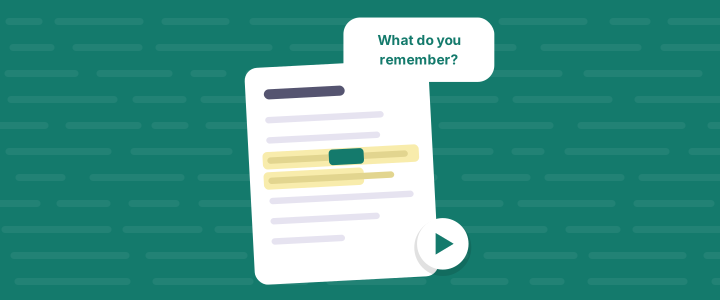
Stop at the end of each section, close the book, and write down what you remember. Check it against the page, then come back to the gaps a day or two later. In a review of ten study methods, self-testing and spacing came out on top; rereading came out near the bottom.
To remember what you read for an exam, the hard part isn’t getting the words in once. It’s getting them back out three weeks later, in a room with no textbook. Every step below is built around that, and they work the same with a printed book, a PDF, or a page read aloud to you.
What rereading does on its own
Less than it feels like. In 2013, Dunlosky, Rawson, Marsh, Nathan and Willingham reviewed the evidence on ten common study techniques. Two got the highest rating: practice testing (quizzing yourself) and distributed practice (spreading study over time). Five got the lowest, among them rereading, highlighting, and summarizing. Dunlosky’s advice: “By just replacing rereading with delayed retrieval practice, students would benefit.” Rereading makes a page feel familiar, and familiar is not the same as remembered.
Five steps that work with any book
- Split the chapter before you start. Mark it into pieces of five to ten minutes’ reading; the headings usually do this for you. In the lecture study below, a 21-minute lecture was cut into four segments.
- Read one section, once, with nothing in your hand. No highlighter, no notes yet. If you have the text read aloud, keep your eyes on the words.
- Close it and write what you remember. Two or three minutes, sentences or a list, no peeking. This is retrieval practice, the step that does the work. Karpicke and Blunt (2011) had 200 students learn science texts either by drawing concept maps or by putting the text away and writing what they recalled. A week later the recall group scored about 50 percent higher. Most students had predicted the opposite.
- Check your note against the page and mark what you missed. Don’t reread the section; scan it for the points your note lacks and write them under a line. Szpunar, Khan and Schacter (2013) found that students quizzed after each segment of a lecture reported mind wandering on 19 percent of checks, against 39 to 41 percent for the other groups, and scored 90 percent on the final test against 76 and 68. Knowing a check is coming changes how you read.
- Come back to the misses tomorrow, then next week. Cepeda and colleagues (2006) pooled 317 experiments and found the best gap between study sessions grows as the test gets further away. For an exam in a month, a few days between returns beats the same evening. Each return is another round of step 3, not a reread.
Do it in Hearald
Hearald reads the page aloud with each word highlighted, marks the sections, and has the note and check built in, so the five steps happen in one place (checked November 2026).
- Open the chapter as a PDF, web page or Google Doc and press play. The words light up as they’re read, and the player marks each section so you can see the next stop.
The printing press reached most of Europe within fifty years of Gutenberg’s Bible, and the price of a book fell with it.
Follow the highlighted words; stop at the end of the section. - When the section ends, pause and write what you remember in the note. Same rule as paper: no peeking.
- Run the check. It lists the section’s key points and shows which ones your note missed.
- Jump back to the part you missed, listen once more, then play on.
- Come back a day later, read your note before you press play, and redo the check where you had gaps.
- 1. Open and playA PDF, web page or Google Doc, read aloud on your machine
- 2. Highlight and markEach word as it’s read, each section as it starts
- 3. Write what you rememberAt the section’s end, text out of sight
- 4. List the key pointsThe check lays out what the section said
- 5. Show what you missedYour note against the points, gaps marked
Where people get it wrong
The usual mistake is testing yourself once at the end of the chapter instead of after each section; by then there is too much to recall and the gaps blur. The second is doing step 3 and skipping step 4, so you never see what you left out. The third is cramming every return into the night before, when the same hours spread over days do more. And this method is for remembering what you read; if the exam asks you to solve problems, practice with the kind of question it will ask.
Recall check
- In the 2013 review of ten study techniques, which two came out with the highest rating, and where did rereading land?
- What do you do the moment a section ends, and what do you do right after that?
- Your exam is three weeks away and you have just checked your notes on a chapter. What happens if you revisit the misses tonight instead of three days from now?
Show answers
- Practice testing and distributed practice were rated highest. Rereading was one of the five rated lowest, with highlighting and summarizing.
- Close the text and write what you remember without looking. Then check the note against the page and mark the points you missed.
- Tonight’s return is close to a reread: the material is still fresh, so recalling it is easy and teaches you little. Three days out the recall is harder, and the spacing research says that is when it does the most for an exam weeks away.
Try it
If you’d rather have the chapter read to you while you follow the words, with a check waiting at the end of each section, give it a shot and put it in your browser.